 Business License

Acupuncture Needle Tip Strength and Sharpness Testing Guide
Acupuncture Needle Tip Strength and Sharpness Testing Guide
Provided by Shanghai Yingle Instrument Co., Ltd.
1. Scope of Application
This guide is based on the GB2024-2016 "Acupuncture Needles" standard and applies to the testing of tip strength and sharpness of acupuncture needles, ensuring compliance with clinical safety and performance requirements.
2. Test Equipment Requirements
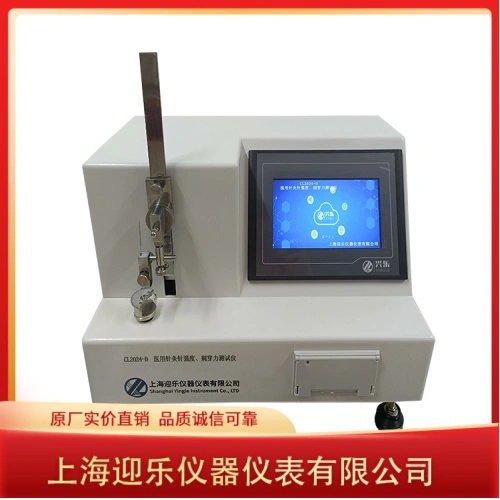
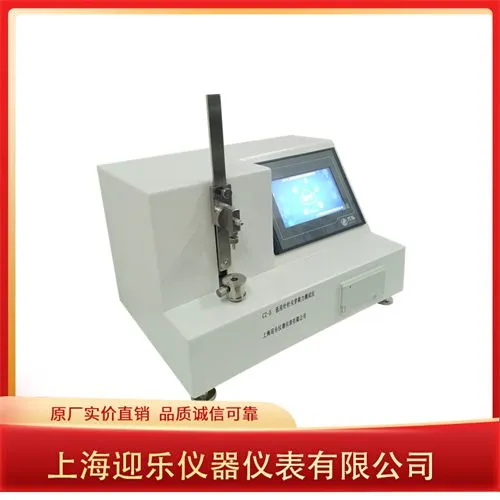
Tip Strength Tester: Equipped with a high-precision force sensor (accuracy ±0.5%), a loading rate control module (≤10mm/s), and a steel block fixture (hardness ≥HRC60, surface smooth and free of rust).
Tip Sharpness Tester: Uses an aluminum foil fixture (foil thickness 0.05mm±0.002mm, purity ≥99.5%), a transmission system (vertical loading accuracy ±0.1N), and a data acquisition module (sampling frequency ≥1kHz).
Auxiliary Tools: 5x magnifying glass, absorbent cotton, optical glass plate (used for the rolling method).
3. Tip Strength Test Procedure
Tip Strength Test
1. Sample Installation: Securely clamp the test acupuncture needle in the needle holder, ensuring the exposed tip length is ≥5mm to guarantee accurate force application during testing.
2. Loading Test: Apply the needle tip vertically onto the steel block, gradually loading to the force value specified in clause 4.3 at the speed specified in B.2.2. The loading process must be smooth and even, avoiding any impact force that could affect test results. After loading, hold for 5s–10s, then remove the load.
3. Result Observation: Carefully examine the needle tip using a 5x magnifying glass. The tip must not show any hooking or bending. Alternatively, drag the needle tip across absorbent cotton. If no fibers are pulled out, the tip strength meets the requirements.
Tip Sharpness Test
1. Foil Preparation: Select an appropriately sized piece of aluminum foil and clamp it flat in the foil fixture. Do not apply any noticeable tensile or compressive force to the foil, so as not to affect its original strength.
2. Puncture Test: Clamp the acupuncture needle (which has already undergone the strength test) in the needle holder. Press the control switch to activate the transmission system, which applies a gradually increasing vertical force from the needle tip onto the aluminum foil. When the force applied by the needle tip exceeds the foil's strength, the tip punctures through the foil and the instrument automatically stops loading. At this point, record the value indicated by the pointer on the pendulum arm (or the value displayed on the instrument). This is the puncture force of the acupuncture needle tip.
3. Instrument Reset: Press the operation control switch button to reset the pendulum arm and pointer (or instrument display) to zero, preparing for the next test.
4. Foil Adjustment: Loosen the foil fixture and reposition the foil inside, ensuring that the distance between each puncture point is greater than 3 times the diameter of the test sample, to prevent adjacent puncture holes from affecting each other.
5. Repeat Testing: Repeat steps 1–4 above for a total of 3 tests. Take the arithmetic mean of the 3 test results. This average value is the sharpness puncture force of the tested acupuncture needle.
4. Precautions
Environment Control: Test environment temperature should be 20–25°C, humidity ≤60%, to prevent moisture from affecting the aluminum foil results.
Equipment Calibration: Calibrate the force sensor and loading rate daily before use to ensure data accuracy.
Sample Handling: Clean the needle tip after testing to avoid residual aluminum foil fragments interfering with subsequent tests.
Data Recording: Fully preserve test curves, raw data, and judgment results to ensure traceability.
This guide provides a scientific basis for acupuncture needle quality control through standardized operating procedures and quantitative judgment methods, helping the industry improve product safety and clinical effectiveness.
Recently Posted
-
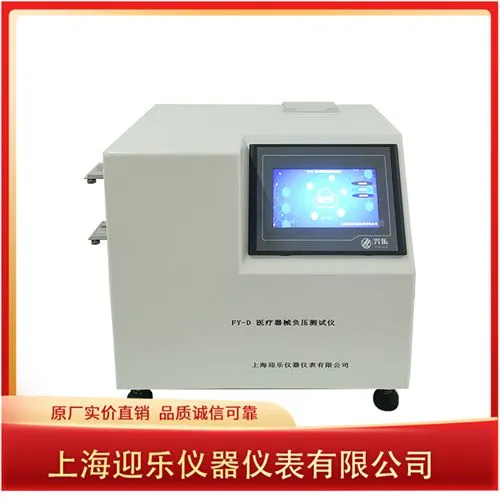
Medical device negative pressure tester
May 22, 2026Product Definition: Medical device vacuum test instrument is a professional equipment used to detect leakage at the piston or seal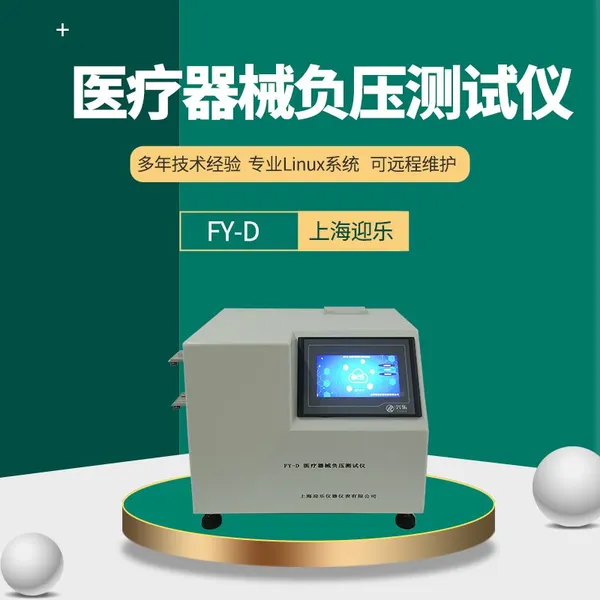 Read More
 -
The TRX-D medical suture needle elastic toughness tester you ordered has been loaded and shipped to
December 4, 2025The medical suture needle testing equipment you ordered has been loaded and shipped. This equipment will enhance the elastic and t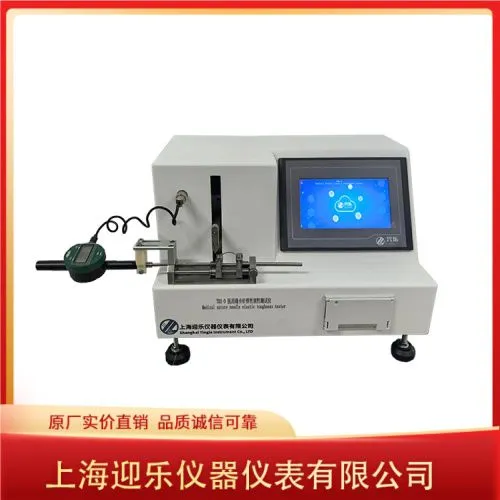 Read More

Contact Us
Recommended Products
-
 Medical Suture Needle Elasticity and Toughness TesterNegotiableMOQ: 1 Combo
 -
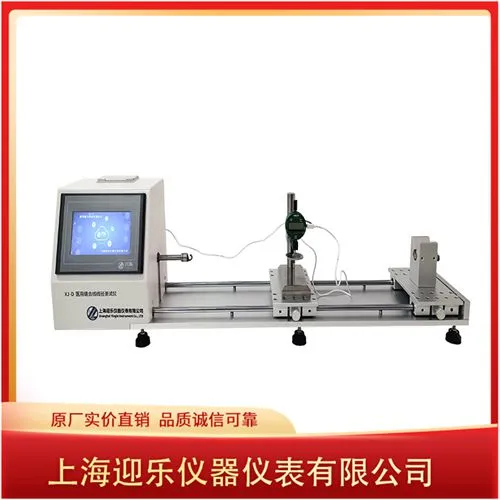
Suture Thread Diameter Measuring InstrumentNegotiableMOQ: 1 Unit
-
Medical Needle Testing Equipment ManufacturerNegotiableMOQ: 1 Piece
-
Medical Needle Tube (needle) Toughness TesterNegotiableMOQ: 1 Combo
-
ISO7864 Standard Medical Needle Needle Tip Puncture Force Testing InstrumentUS$ 3000 - 4800MOQ: 1 Combo
-
Medical Suture Tensile Strength TesterUS$ 3000MOQ: 1 Piece
-
Disposable Syringe (needle) Stiffness TesterUS$ 30000 - 48000MOQ: 1 Bag
-
Medical Syringe Needle Piston Sliding Test MachineUS$ 3000 - 4800MOQ: 1 Combo
-
Medical Syringe Body Tightness Positive Pressure Test Instrument Body Leakage Piston Thrust DetectionNegotiableMOQ: 1 Combo
-
Syringe Leakage Negative Pressure Tester for Research Institute Testing InstituteUS$ 30000 - 48000MOQ: 1 Set
-
Intravenous Needle Connection Firmness TesterUS$ 3000 - 4800MOQ: 1 Combo
-
Medical Injection Needle Tip Tensile Tester and Connection Firmness TesterUS$ 3000MOQ: 1 Combo
-
Medical Injection Needle Tip Tensile Tester and Connection Firmness TesterUS$ 3000MOQ: 1 Combo
-
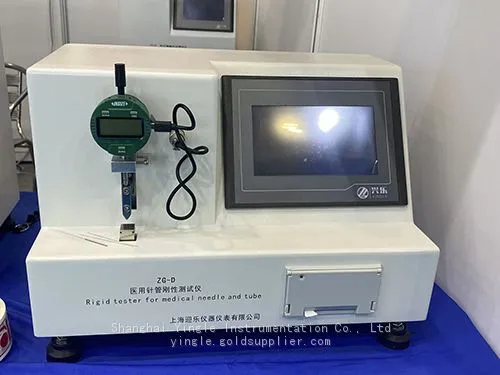
Medical Injection Needle Rigidity Testing Machine Shanghai Yingle ManufacturerNegotiableMOQ: 1 Combo
-
Syringe Needle Puncture Force TesterNegotiableMOQ: 1 Piece
-
Medical Instrument Needles and Catheters Fracture Force and Connection Strength Test MachineUS$ 3000MOQ: 1 Combo
-
Disposable Hypodermic Needle Toughness TesterUS$ 30000 - 48000MOQ: 1 Combo
-
WD-DPrecision Medical Syringe Sliding Performance Tester Professional Testing MachineUS$ 3000 - 4800MOQ: 1 Combo
-
Medical Sterile Needles Penetration Force Tester/Disposable Needle Tip Puncture Force Test MachineNegotiableMOQ: 1 Piece
-
Medical Syringe Tester Syringe Pull Force Testing Instruments Push Force Measurement for SyringeUS$ 3000MOQ: 1 Combo